


Real-Time Streaming Protocol (RTSP)
Low-Latency IP Camera Ingest

Real-Time Streaming Protocol (RTSP)
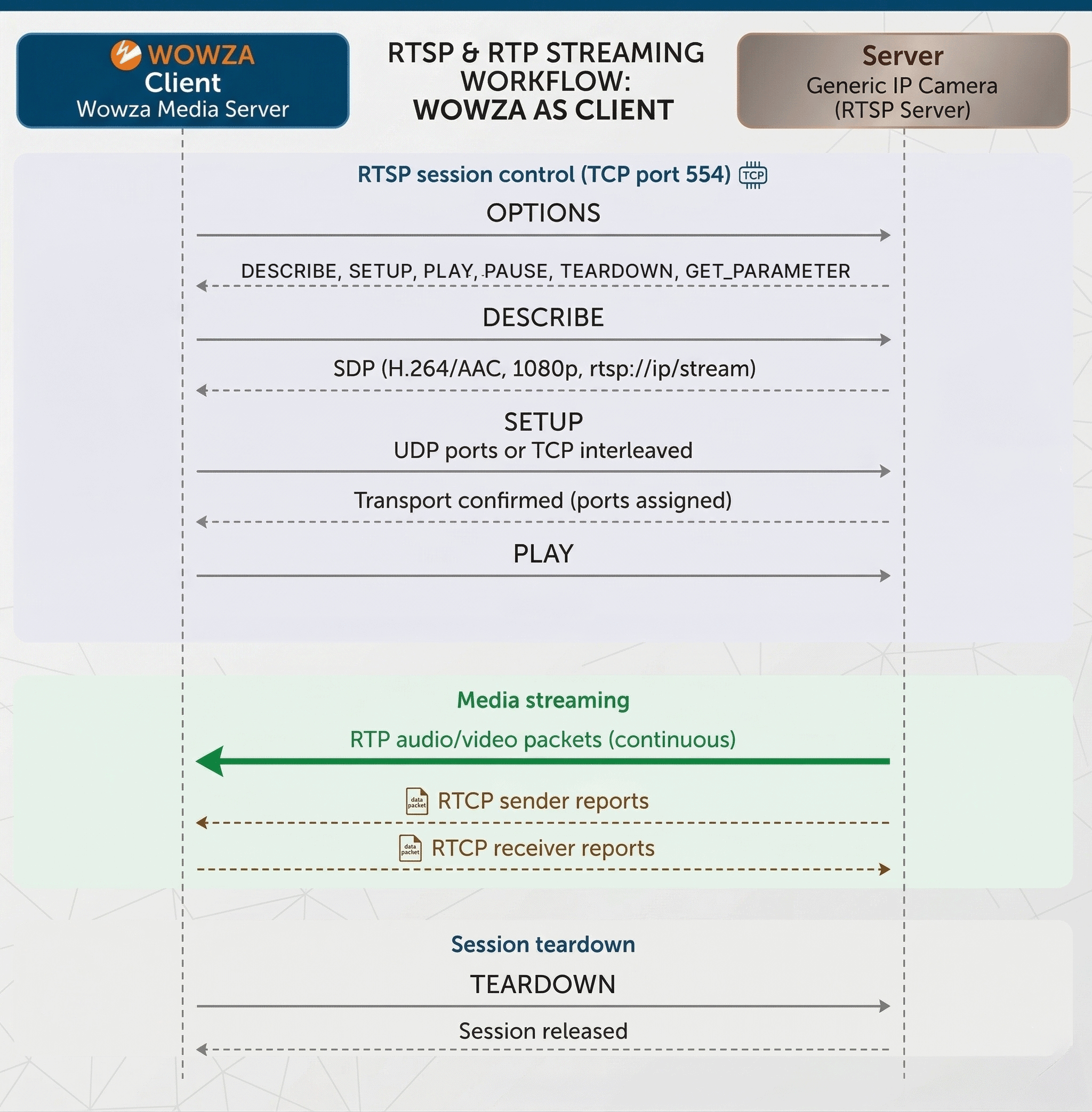
RTSP (Real-Time Streaming Protocol) is the standard control protocol for IP cameras and surveillance video. RTSP establishes and manages a media session while its companion protocols carry the stream. RTP transports the audio and video, and RTCP reports delivery quality. Nearly every IP camera speaks RTSP, which makes it the dominant first-mile path for pulling live camera feeds into Wowza Streaming Engine for transcoding, recording, and multi-protocol delivery.
RTSP Benefits Include:
- Universal IP Camera Support: RTSP is built into nearly every IP camera and ONVIF-compliant device.
- Low-Latency Contribution: RTSP/RTP can deliver sub-second end-to-end latency on a local network, fast enough for real-time monitoring when paired with an ultra-low-latency playback protocol like WebRTC.
- Flexible Transport: RTSP runs over TCP port 554, carries RTP over UDP by default, or over a single TCP interleaved connection for firewall-friendly delivery.
- Codec Support: H.264 and H.265/HEVC video with AAC and MP3 audio ingest directly, and Wowza normalizes any source for downstream delivery.
- Secure Transport: SRTP encrypts the media payload and RTSPS secures the control channel, protecting camera feeds and encoder contribution across untrusted networks.
Ingest & Republish RTSP with Wowza Streaming Engine


Wowza Streaming Engine acts as a full RTSP server and client.
One ingest path feeds many delivery paths, all from the same media server:
- Ingest an RTSP/RTP stream from an IP camera or encoder and repackage it for delivery over HLS, LL-HLS, MPEG-DASH, or WebRTC without building a second workflow.
- Serve an ingested source back out over RTSP/RTP to RTSP-based players and video management systems on the network.
- Republish a live source to other platforms over RTMP, SRT, MPEG-TS, HLS, or MPEG-DASH when a downstream destination does not accept RTSP.

Wowza Streaming Engine’s RTSP implementation includes:
- Flexible Transport Modes: Feed RTSP over TCP, pull RTP over UDP for lowest latency, RTP interleaved over TCP for firewall-friendly delivery, and accept RTSP/RTP tunneled over HTTP, configured per application or per stream.
- Server-Side Transcoding: Generate adaptive bitrate renditions, normalize codecs, and produce HEVC/H.265 output for efficient delivery (Windows and Linux).
- REST API and Automation: Create applications, provision camera stream files, and configure ingest programmatically through the Wowza Streaming Engine REST API for repeatable, infrastructure-as-code deployments.
- Deployment Flexibility: Runs on bare metal, virtual machines, or Docker containers, on-premises, hybrid, cloud, or at the edge, behind the same load balancers and gateways as the rest of the stack.
Applications of RTSP for Wowza

Wowza Streaming Engine takes RTSP ingest and turns it into whatever is needed downstream:
- A reliable, low-latency contribution path from any IP camera, including ONVIF-compliant ones, or RTSP encoder into streaming infrastructure.
- A single camera ingest that reaches many viewers at once, transmuxed into HLS or DASH for CDN-scale delivery or WebRTC for real-time monitoring.
- A bridge between RTSP-only camera systems and current HTTP-based and real-time delivery.
Wowza also extends RTSP across the surveillance and monitoring workflows you already run in production:
- Consolidate Camera Fleets: Pull hundreds of RTSP cameras into a single origin and provision each feed on demand through the REST API.
- Build Redundant Ingest Paths: Point primary and backup camera streams at the same application so monitoring continues if one feed drops.
- Deliver Feeds To Any Endpoint: Convert an incoming RTSP feed to WebRTC for sub-second monitoring by operators, with HLS and DASH serving large audiences from the same ingest.
- Control Who Can Publish: Require Basic or Digest RTSP authentication and whitelist specific IP addresses so only approved cameras and encoders can push to ingest endpoints, separate from the media encryption SRTP provides in transit.
- Pin Ingest to the Edge: Run RTSP ingest on containers close to the camera network to keep the first mile short and controlled, then hand off to cloud or hybrid infrastructure for transcoding and multi-protocol delivery.
Frequently Asked Questions
What is RTSP?
RTSP (Real-Time Streaming Protocol) is an application-level control protocol that establishes and manages media sessions between a source or player and a streaming server. RTSP does not carry media itself. It issues session commands such as SETUP, PLAY, PAUSE, and TEARDOWN while RTP transports the audio and video and RTCP reports delivery quality. IP cameras rely on RTSP almost universally, so Wowza Streaming Engine ingests RTSP/RTP, then transcodes, records, and repackages it for delivery over protocols like HLS, DASH, CMAF, and WebRTC.
What is RTSP latency?
RTSP/RTP contribution can achieve sub-second end-to-end latency on a local network, and RTP over UDP can reach sub-300-millisecond latency in optimal conditions. RTSP adds negligible delay because it only controls the session while RTP carries the media continuously rather than in large segments. The total glass-to-glass delay a viewer experiences depends mainly on the delivery format.
How does RTSP streaming work?
RTSP opens a control connection from the client to the server, usually on TCP port 554, and negotiates the session with SETUP, PLAY, PAUSE, and TEARDOWN commands. RTP then carries the audio and video packets with timestamps and sequence numbers, and RTCP reports packet loss and timing. Wowza Streaming Engine either pulls an RTSP/RTP source from an IP camera or receives a stream from an RTSP encoder, then transcodes, records, repackages, or serves the feed to players.
What is the difference between RTSP and RTP?
RTSP controls the session while RTP transports the media. RTSP establishes, plays, pauses, and tears down a stream, and RTP carries the actual audio and video packets with the timing and sequencing that keep playback synchronized. RTCP accompanies RTP to report delivery quality. The three protocols work together, which is why the ingest path appears commonly as RTSP/RTP.
What is the difference between RTSP and RTMP?
RTSP and RTMP both serve as first-mile contribution protocols, but for different sources. RTSP is the native protocol of IP cameras and surveillance devices, and it separates session control (RTSP) from media transport (RTP). RTMP is the dominant protocol for software and hardware encoders pushing to social platforms and CDNs, and it carries media over a single persistent TCP connection. Wowza Streaming Engine ingests both and repackages either one for delivery over HLS, DASH, CMAF, and WebRTC.
What is the difference between RTSP and HLS?
RTSP is a contribution protocol that carries camera and encoder video to a server with low latency, while HLS is a delivery protocol that streams segmented video to viewers and scales easily over CDNs. Wowza Streaming Engine commonly ingests RTSP and repackages it into HLS for playback. This comparison shows where each protocol fits:
| Attribute | RTSP | HLS |
| Primary role | Contribution / first-mile ingest (IP cameras) | Last-mile delivery to viewers |
| Transport | RTSP control over TCP port 554, RTP media over UDP or interleaved TCP* | HTTP / HTTPS, segmented files |
| Typical latency | Sub-second on a local network | 6-30 seconds (sub-2s with LL-HLS) |
| Browser playback | Not native | Native or via standard players |
| Scalability | Low, point-to-point only | High, CDN-friendly |
* RTSP uses TCP port 554 by default, RTSPS uses TCP port 322, and RTP uses UDP ports negotiated during session setup. Ports are user-defined and can be configured to match whatever a network administrator requires.
Is RTSP free?
Yes. RTSP is an openly published IETF standard with no licensing fee, and the open-source tools that speak it, such as FFmpeg and VLC, are free to use. Most production deployments pair RTSP with a commercial media server such as Wowza Streaming Engine to handle ingest, transcoding, recording, security, and multi-protocol delivery at scale.
Does RTSP support encryption?
RTSP sends session control unencrypted over TCP port 554 by default. For secure workflows, SRTP encrypts the media payload and RTSPS wraps the control channel in TLS over TCP port 322. Wowza Streaming Engine supports SRTP for media encryption, so camera feeds and encoder contribution stay protected across untrusted networks. RTSPS secures only the control channel, so the media still requires SRTP for full encryption.
How do you set up RTSP streaming in Wowza Streaming Engine?
RTSP streaming in Wowza Streaming Engine takes three steps:
- Create a live application in Wowza Streaming Engine to receive or pull the stream.
- Point Wowza Streaming Engine at an IP camera’s RTSP URL with a stream file, or configure an RTSP encoder to publish to the application using the server URL (rtsp://host:port/appName).
- Transcode the source
Why does an RTSP stream fail to connect?
An RTSP stream usually fails to connect because of:
- A source authentication mismatch
- A firewall blocking TCP port 554 or the RTP UDP port range
- An incorrect camera or stream URL
- A transport mode the network does not allow
When source authentication is enabled in Wowza Streaming Engine Manager, the camera or encoder credentials must match exactly. Confirming the RTSP URL and application name comes next. If the stream still does not connect, switching the transport mode from UDP to interleaved TCP often resolves firewall and NAT problems, because interleaved RTP travels over the same TCP connection as RTSP control.
Is RTSP still used for live streaming?
Yes, RTSP remains the standard protocol for IP cameras and surveillance systems. THis is because nearly every camera supports it, and it delivers a stable, low-latency feed. Its role centers on first-mile ingest rather than playback. Browsers do not play RTSP, so production deployments use a media server to ingest the stream and deliver it to viewers over HLS, DASH, or WebRTC.